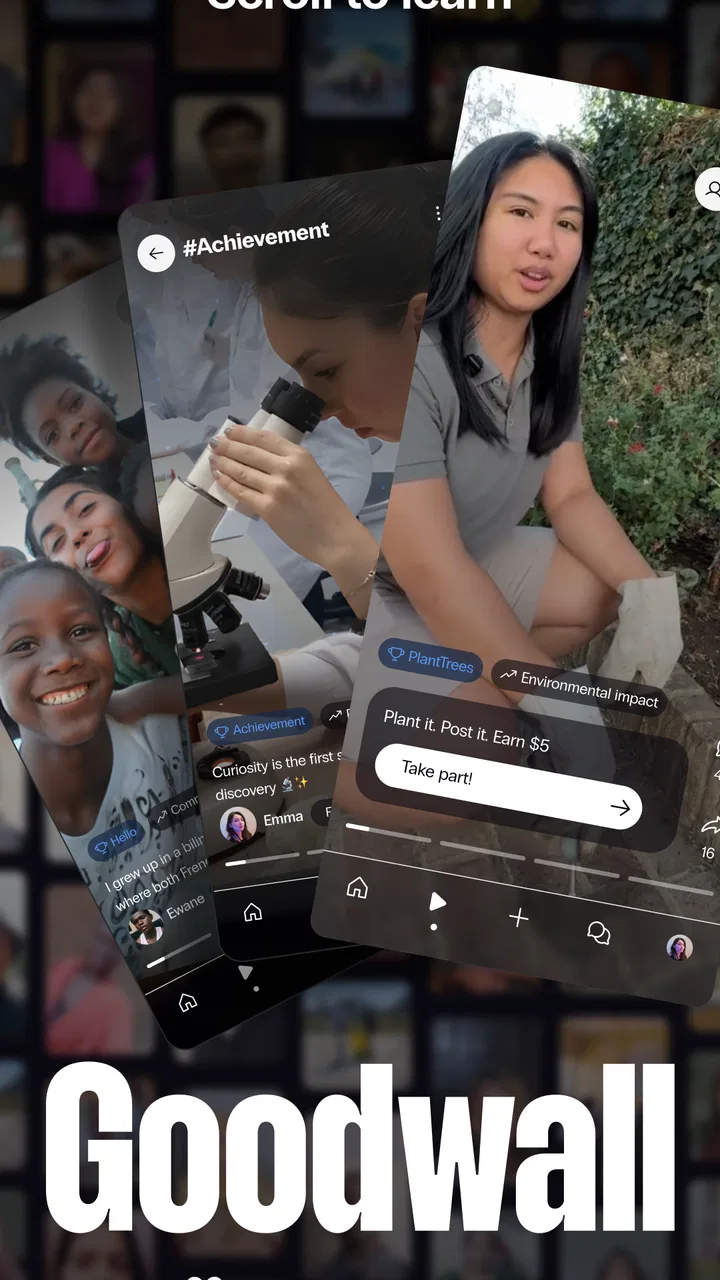
Goodwall - Learn & Earn
- 4.3
- Rating
- 5.00M
- Installs
- Free
- Price

 Analysis by App-foxy
I approached Goodwall - Learn & Earn as a social app for people trying to make progress with education, skills, and future opportunities rather than as a general-purpose chat platform. It is developed by Goodwall and sits in the Social category, but its purpose feels more focused than simply collecting contacts or scrolling through updates. The central appeal is the chance to present what you are learning, discover useful opportunities, and connect your online activity with longer-term personal goals.
That focus matters because many social networks are designed to keep you entertained for as long as possible. This one is easier to judge by a different question: does it help you become more visible, more prepared, or more intentional about your next step? In my experience, the answer depends heavily on how actively you use it. If you only browse, it can feel like another feed. If you treat it as a place to organize your ambitions and show what you can do, it becomes much more useful.
A free starting point with a clear audience
The app is free to use, which makes the initial decision straightforward: you can try it without committing money. That is important for students, early-career users, and anyone exploring education or work options with a limited budget. I would still separate “free to download and use” from guaranteed financial value. The app can provide access to a social learning environment, but it cannot promise that every opportunity, connection, or result will lead to income.
You May Also Like

 Blood Strike: 2.5 Anniversary
Blood Strike’s Loadouts Turn Every Drop Into a Tactical Gamble
A close look at Blood Strike’s custom loadouts: how fast access to signature weapons reshapes its battle royale rhythm, rewards preparation, and narrows the gap between fights.

 Pandora - Music & Podcasts
Pandora’s Music Is Easy to Start, but Harder to Recover
Pandora’s strength is its low-effort path from a seed to a station. Its weak spot is how much confidence it asks you to place in connection, setup, and quiet recovery.

 8 Ball Pool
 Is Built on Rivalries, Rematches, and Routine
A close look at the rivalries, rematches, shared routines, and unanswered safety questions that turn a quick pool match into a persistent mobile community.

 Samsung Music
’s Quiet Strength Is Playing What You Already Own
Its reach comes less from spectacle than from dependable access to a personal library. That simplicity is both the app’s strongest retention engine and its ceiling.

 AccuWeather: Weather Radar
AccuWeather Review: A Quick, Clear Forecast for Everyday Decisions
For everyday plans, the best forecast is the one you can understand quickly. AccuWeather makes rain timing, radar, and local conditions easy to act on, with a few trade-offs.

 Hill Climb Racing
Why Hill Climb Racing Still Turns Crashes Into One More Run
A tiny car, a bumpy hill and one more upgrade: Hill Climb Racing keeps resurfacing because its simple chaos makes every near-miss feel personal.
More From Our News Desk
View All News


Goodwall is intended for a Teen audience, so it is particularly relevant to younger people beginning to think about studies, skills, projects, volunteering, and employment. The app was released on March 7, 2016, and its current version is 1.10.11.1. It supports Android 7.0 and later, which means people using older devices should check compatibility before planning around it.
Its reach is substantial, with over five million installs and an average rating of 4.3 from roughly twenty-three thousand ratings. Those figures suggest that the concept has attracted a sizeable audience, but they should not replace your own test. Social apps are highly personal: the usefulness of the community you encounter can vary according to your interests, location, age, and how complete your profile is.
What the app is trying to help you do
The most convincing way to use Goodwall is as a public record of progress. Instead of keeping every achievement in a private folder, you can use the app’s social setting to make your interests and development easier for other people to notice. That could be valuable when you are still building experience and do not yet have a long professional history.
I would not treat it as a replacement for a formal résumé, a school application system, or a dedicated professional network. It works better alongside those tools. A résumé is usually concise and targeted; a social learning profile can show a broader picture of what motivates you and what you are working toward. The trade-off is that a broader profile requires more judgment. Posting everything does not automatically make you look capable. Selecting meaningful activities and explaining what you learned is more effective.
The “learn and earn” idea also needs a realistic interpretation. The app’s name can make the financial side sound immediate, but I would approach it as a way to find or prepare for opportunities rather than as a dependable income source. Your results will depend on the opportunities available to you, the quality of your profile, and the effort you put into following through. Free access is the confirmed value; any financial outcome should be treated as conditional, not promised.
How I would use it during an ordinary week
Imagine a student who spends a Saturday completing a short course, helping with a community project, or building a small portfolio piece. The easy mistake would be to record only the title of the activity. A stronger approach is to note the practical skill involved, the problem solved, and what changed as a result. That gives the activity context and makes it easier for someone else to understand its value.
On another day, that student could browse the social side with a specific purpose instead of endlessly checking updates. They might look for people with similar interests, compare how others describe their projects, and identify opportunities that match their current level. The useful habit is to turn browsing into a short research session: decide what you are looking for before opening the app, save the relevant details elsewhere, and return later to act on them.
This workflow reveals one of the app’s less obvious strengths. A social education platform can help you notice gaps in your own presentation. If other users explain their interests clearly while your profile is vague, the comparison gives you a practical reason to improve your wording. That is more useful than simply chasing visibility. The goal is not to imitate another person’s profile, but to understand what information helps a reader quickly see your direction.
Building a profile that does more than list ambitions
For someone new to professional networking, the profile can be treated as a work-in-progress rather than a final identity statement. I recommend starting with a narrow theme. For example, choose one area you are genuinely exploring and make your first contributions consistent with it. A focused beginning is easier to understand than a collection of unrelated claims.
Another useful technique is to connect learning with evidence. Saying that you are interested in design is less informative than describing a design exercise, a community task, or a personal project and explaining the decision you made. Even when the activity is small, the explanation shows reflection. That is the kind of detail that can make a social profile feel credible rather than promotional.
There is also a privacy and reputation trade-off whenever you share progress publicly. Younger users should be careful about posting personal contact information, precise routines, or details that identify where they live or study. A profile can support opportunity-seeking without revealing everything about your private life. I would review every post as if a teacher, mentor, or future recruiter might see it later, while still keeping the tone natural.
Where it differs from familiar alternatives
Compared with a general social network, Goodwall has a more purposeful reason for existing. You are less likely to use it purely for family updates or casual entertainment, and that can make the time spent there easier to justify. The downside is that it may feel less lively if you want a broad social circle, fast-moving entertainment, or conversations unrelated to education and personal development.
Compared with a professional networking service, it appears more approachable for people who are still at the beginning of their journey. You do not need a long employment history to have something worth sharing. A course, project, interest, or community contribution can be a starting point. However, users who already have extensive professional experience may find a specialized career platform more efficient for recruiting, detailed work histories, and industry-specific contacts.
Compared with a learning platform, the social element is the main distinction. A course platform is usually better when you want structured lessons, assessments, or a defined curriculum. Goodwall is more useful when you want to connect learning with identity, visibility, and opportunity discovery. If your only goal is to master a subject through a carefully sequenced program, I would choose a dedicated learning service first and use this app as a companion.
The friction you should expect
The biggest limitation is that social value depends on participation. A well-designed profile cannot create a meaningful network by itself. You may need patience before the app feels relevant, especially if your interests are narrow or the people you encounter are not active in the same areas. This is not a flaw unique to Goodwall, but it is important because the app’s usefulness is less immediate than that of a tool that solves one isolated task.
There is also a risk of turning personal development into performance. If every course, project, or volunteer activity becomes something to display, you may start choosing activities for appearance rather than genuine growth. I found the concept more valuable when the social layer followed real learning instead of replacing it. Use the app to document progress, not to make progress look larger than it is.
Another trade-off is attention. A feed can encourage frequent checking, while the most valuable work often happens away from the screen. I would set a simple boundary: use the app to discover, reflect, and connect, then move to the actual course, project, application, or conversation. If you find yourself browsing without taking any action, the app has shifted from a tool into a distraction.
Who is most likely to benefit
I think the strongest audience is teenagers and young adults who are beginning to build a record of interests but do not yet feel ready for traditional professional networking. It can also suit students who want a place to make their learning more visible, people exploring possible career directions, and users who enjoy discovering opportunities through a community rather than searching alone.
It is especially useful if you can answer three questions before joining: what area am I exploring, what evidence can I share, and what kind of opportunity am I hoping to find? You do not need perfect answers, but having a direction makes the experience more productive. Without one, the app may become a vague stream of inspirational content with no clear next step.
Mentors, educators, and community-minded users may also appreciate the environment because it gives them a way to encourage younger people and exchange ideas. The value here is not simply the number of contacts. A thoughtful connection that helps you understand a skill or opportunity can matter more than a large list of names.
Who should choose something else
I would skip Goodwall if you want a private notes app, a complete course library, or a guaranteed way to earn money. Its social design means that sharing and interaction are part of the experience, so someone who prefers to keep all development work private may feel uncomfortable. Likewise, if you need a formal job-search database with highly detailed employment tools, a dedicated career service may be a better fit.
I would also hesitate if you are looking for instant results. This is not the kind of app I would install on a Monday expecting a job, scholarship, or paid project by the end of the week. It makes more sense as a gradual investment: improve how you describe your abilities, follow relevant people, notice suitable opportunities, and apply what you learn elsewhere.
My verdict on the free value
Goodwall earns a place on my recommended list for the right user, mainly because the free entry point removes a major barrier to experimentation. The app gives young people a social setting for connecting education, skills, and future plans, and that combination is more useful than a generic feed when used deliberately.
My recommendation comes with a condition: do not judge it by passive scrolling or by the promise implied in its name. Judge it by whether it helps you explain what you are learning, discover relevant possibilities, and take concrete action outside the app. That is where its value becomes real.
With its Teen rating, broad Android compatibility from version 7.0 onward, and established presence in the social-app space, it is easy enough to try without paying. The current 4.3 average across about twenty-three thousand ratings is encouraging, while the roughly five hundred twenty written reviews offer additional signs that users have engaged seriously with it. Still, your experience will depend on your goals and the quality of your participation.
My final advice is simple: install it if you want to turn learning and early achievements into a visible, purposeful story. If you need structured instruction, private organization, or dependable income, choose a more specialized tool instead. For a motivated young user willing to contribute rather than merely browse, Goodwall can be a worthwhile free complement to school, courses, and traditional career resources.
FAQs for Goodwall - Learn & Earn
01What is Goodwall - Learn & Earn, and how does it work?
Goodwall - Learn & Earn is a social and professional development app designed to help users build skills, discover opportunities, and showcase their achievements. After creating a profile, you can complete learning activities, participate in challenges, explore career-related content, and connect with organizations. Some activities may provide rewards or recognition, although availability and eligibility can vary by location and campaign.
02Can I really earn money or rewards with Goodwall?
Goodwall may offer rewards through selected challenges, campaigns, surveys, learning programs, or other partner opportunities, but earnings are not guaranteed. The amount and type of reward depend on the specific activity, your eligibility, regional availability, and the campaign rules. Before participating, carefully check the requirements, deadlines, verification process, and withdrawal conditions shown inside the app.
03Is Goodwall suitable for students and young professionals?
Yes. Goodwall is primarily aimed at students, graduates, and young professionals who want to improve their employability and discover educational or career opportunities. Users can present skills, certificates, projects, volunteering, and other accomplishments in a digital profile. However, age requirements and access to certain opportunities may differ, so review the platform’s current terms before registering.
04Is Goodwall free to download and use?
Goodwall can generally be downloaded and used without an upfront purchase, allowing users to create a profile, browse opportunities, and access available development activities. Some special programs or partner opportunities may have separate eligibility rules, and mobile data usage may apply. Always review the app-store listing and in-app terms to confirm whether any optional costs or conditions apply.
05What personal information does Goodwall require, and is it safe to use?
To provide personalized opportunities and support a professional profile, Goodwall may request information such as your name, age, location, education, skills, interests, and achievements. You should read the privacy policy before submitting details and avoid sharing sensitive information unnecessarily. Use a strong password, check profile visibility settings, and remember that public achievements may be viewed by other users or organizations.
Pros
- Rewards users for completing learning and career-building activities.
- Offers opportunities to discover internships
- jobs
- scholarships
- and challenges.
- Profile tools help showcase skills
- achievements
- interests
- and experience.
- Community features can connect users with peers and potential employers.
- Useful for students and early-career users seeking practical opportunities.
Cons
- Some rewards and opportunities may be limited by country or eligibility.
- Earning potential is modest and should not be treated as a regular income.
- The app may require considerable profile information to personalize suggestions.
- Competition for featured opportunities can be high.
- Notifications and promotional content may feel excessive for some users.

Goodwall - Learn & Earn
Gallery